Arthralgias, myalgias, and herx—oh my! (Symptom vocabulary for TBIDs) 05/22/2012
Posted by thetickthatbitme in TBI Facts, Tick-Lit, Treatment.Tags: antibiotics, arthralgia, Bell's palsy, Borrelia, herx, Herxheimer reaction, Lyme Disease, medicine, myalgia, pulse, supplements, tachycardia
add a comment

Oh no, not a Borrelia infection!
This is part one in a multi-part series on vocabulary related to tick-borne infectious diseases (TBIDs). Today, we focus on symptoms. You can find all these terms and more on the Glossary page.
arthralgia: a fancy medical term for joint pain. The origin is Greek (arthro- = joint; -algos = pain). Arthralgias may be a symptom of injury, infection, illness, or an allergic reaction. They are a common symptom with TBIDs like Borrelia burgdorferi (Lyme Disease), Borrelia hermsii (TBRF), and Babesia.
myalgia: a fancy medical term for muscle aches. Myalgias can be a symptom of infection with Borrelia burgdorferi (Lyme Disease), Borrelia hermsii (TBRF), Babesia, Ehrlichia, Anaplasma phagocytophilum, Rocky Mountain Spotted Fever, Toxoplasmosis, Malaria, or Influenza. They can also be a symptom of inflammatory diseases like Multiple Sclerosis.
Bell’s palsy: This is a paralysis of the muscles in the face caused by damage to the seventh cranial nerve. It is often unilateral (only on one side), and it’s more commonly seen in patients with Borrelia burgdorferi. As you may know, one of the consequences of Borrelia infection is inflammation, and this inflammation can lead to loss of nerve function. You can read more about Bell’s palsy here. Patients with Borrelia infections may also have damage to the eighth cranial nerve (also known as the auditory vestibular nerve), which can result in tinnitus (ringing of the ears) and problems with balance.
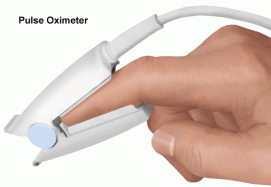
A pulse oximeter measures pulse and oxygen. Image via Yale Medical Group.
postural tachycardia: Tachycardia is a heart rate that exceeds the normal range (usually indicated by a pulse greater than 100). Some people with infections have tachycardia all the time, but many only have postural tachycardia, which is tachycardia when you stand up for 3 minutes after lying down for 3 minutes. According to my doctor, this has been a great predictor of whether a patient has an infection, and he puts every new patient though the “tilt test”: lie down three minutes, have your vitals taken, stand up 3 minutes, have your vitals taken. Often, the difference in lying and standing pulse will decrease over the course of treatment.
herx: Herx is short for Herxheimer reaction (or Jarisch-Herxheimer reaction). It was named after dermatologists Adolf Jarisch and Karl Herxheimer in the late nineteenth century, who discovered it while treating Syphilis patients with mercury. (Fun fact: Herxheimer was a colleague of Paul Ehrlich, for whom Ehrlichia is named. They both helped found the University of Frankfurt. Not-so-fun fact: Herxheimer was murdered in 1942 by Nazis at Theresienstadt; he was 81.) A Herxheimer reaction can occur when one is being treated for an infection with antibiotics. It’s thought to be caused by the endotoxins that are released as bacteria start to die off. Herx are characterized by fever, chills, rigor (shaking), hypotension, headache, tachycardia, hyperventilation, vasodilation with flushing, myalgia (muscle pain), and exacerbation of skin lesions.
I’ve discovered a bit of an inconsistency when it comes to information available online and in published research about herx. Almost every Lyme patient blog I’ve ever read mentions herxing. I was herxing bad today, etc. Many patient and doctor organizations related to the treatment of Lyme Disease also discuss herxing. They characterize herxing as common among patients with Borrelia infections and as a sign that antibiotics are working. Herx seems to be used liberally as a term that means any sort of increased discomfort that a patient feels while undergoing antibiotic treatment.
For the sake of comparison, let me tell you how a medical textbook describes the Herxheimer reaction. I’m using as my reference Principles and Practices of Infectious Diseases, seventh edition (borrowed, not bought). I’ll start with the Herxheimer reaction as studied in patients with Borrelia hermsii (TBRF) infections. A herx in hermsii patients is characterized by severe rigors, increase in temperature, and decrease in blood pressure. The onset of reaction occurs within 2 hours of initial therapy and coincides with clearing of spirochetes from the blood. This means that in order to have the reaction you have to have spirochetes in the blood (which would be indicated by a positive blood smear). You’ll also notice that the reaction happens on the first day of treatment.
According to Principles and Practices, herx occur in 30-40% of patients with Borrelia hermsii infections. When a herx does occur, medical attention is necessary because there is a possibility of fatality. Aspirin is sometimes given to lower the fever. A saline infusion can be given to increase blood pressure. If the reaction is very severe, the patient may have to be given steroids. In sum, if you have an acute Borrelia hermsii infection and are treated with antibiotics, there is a chance that you will have a herx reaction the first day of treatment. If you are having a true herx, you will probably need immediate medical attention.
Now, you may remember that I had Borrelia hermsii, and upon reading the above information, I was really curious as to why I never experienced one of these reactions. When I asked my doctor about it, he explained that it was because I had a latent infection. In other words, I did not receive treatment until several years after I was infected. My body had already tried to fight off the bacteria, and had partially succeeded because my infection was no longer acute. This meant I did not have a high load of bacteria in my blood. So even though some days my joint and muscle pain worsened and I felt sick to my stomach, because I didn’t have the shaking, the fever, and the low blood pressure and because the bacteria was hiding in my joints, not in my blood, I never had a herx reaction. Dr. W went on to say that he has treated more than 50 people with B. hermsii infections, and he has never seen a herx in clinic. He has, however, seen some fever-chill reactions when patients with hermsii were being treated with Ceftriaxone. “And those weren’t herx?” I asked. He didn’t believe so; rather, he thought that the fever and chills were because Ceftriaxone wasn’t killing the bacteria quickly enough. When he switched those patients to Ertapenem, a stronger antibiotic, the fever and chills went away, and the patients saw improvement in their conditions.
Now here’s what Principles and Practices has to say about herx in patients with Borrelia burgdorferi (Lyme Disease). The reaction occurs during the first 24 hours of therapy, and consists of high fever, a redder rash, and greater pain. Some vasodilatation may also occur. The Herxheimer reaction occurred in approximately 15% of patients. Only 15 percent! That was shocking to read. There were also no reported deaths from Herxheimer reactions during antibiotic therapy for Lyme Disease.
Clearly, the rate of herx reactions in studies did not match my impression from anecdotal accounts from patients, so I asked Dr. W if he could offer any explanation. His hypothesis was that since most B. burgdorferi (Lyme) patients have latent (long-term) infections and not acute (new) infections, they are probably not having true herx reactions. However, since some doctors prescribe a lot of different supplements to be taken while patients are undergoing antibiotic therapy, perhaps some of the symptoms that patients feel are adverse reactions to the supplements. Because supplements are not subject to the same FDA regulation as pharmaceuticals, the companies that manufacture them are not required to prove their safety or effectiveness. Consequently, very little is known about how these products interact with prescription and over-the-counter medications. To read more about supplements and regulation, go here.
Here’s what I take away from all this:
- Herxheimer reaction is a medical term used to describe a specific set of symptoms in a specific set of patients (those with acute Borrelia infections) which may be life threatening (in the case of very high fever and very low blood pressure), particularly in patients with Borrelia hermsii infections.
- The term “herx” has been adopted by both the LLMD (Lyme-literate medical doctor) community and the Lyme patient community and has evolved into a generic, non-clinical term that means discomfort or worsening of symptoms that occurs multiple times throughout the course of antibiotic treatment.
- Just because a patient is experiencing discomfort does not mean he or she is having a true Herxheimer reaction.
- Contrary to what some doctors say, there is nothing worrisome about a patient who does not have a Herxheimer reaction, as they only occur in 30-40% of B. hermsii patients and 15% of B. burgdorferi patients.
- Some episodes of high fever and chills during antibiotic therapy might mean that the antibiotic is NOT working well enough. Patients sometimes benefit by being switched from Ceftriaxone to Ertapenem.
- Because some patients take a number of supplements in addition to antibiotic therapy and none of these are properly regulated by the FDA and studied in clinical trials, their effect on the body is unpredictable. It’s possible that some reactions that patients believe are Herxheimer reactions are actually reactions to other things they are taking.
Related articles
- My Story (thetickthatbitme.com)
- Ceftriaxone (Rocephin): Is your doctor following directions? (thetickthatbitme.com)
- Curious about Tick-borne Infections? (thetickthatbitme.com)
This week’s choline diet highlights 05/20/2012
Posted by thetickthatbitme in Uncategorized.Tags: breakfast, choline, Coleslaw, Cooking, diet, eggs, health, recipe, Rye bread
add a comment
I tried to be good and cook simple, choline-rich meals at home this week. Here are some highlights:
McBreakfast Sandwich
I love making my own version of a fast food breakfast sandwich for several reasons. One, it’s healthier because I can use better ingredients. Two, it’s relatively inexpensive. Three, I don’t have to drive anywhere to get it.

Start with an egg and a slice of Canadian bacon.
Sometimes I use an English muffin or a bagel, but this week I didn’t have those, so I used sourdough, which I actually like better. I also subbed out boring old American cheese for some spicy pepperjack.

Pepperjack on toasted sourdough. They’re big slices, so I just used one and folded it in half.
To drink, I had Treetop orange-pinapple juice, which I water down.

Choline count: fried egg (125 mg) + Canadian bacon (19 mg) + sourdough bread (15 mg) = 159 mg

Rainbow Coleslaw
I grew up on traditional southern-style coleslaw, and when the weather gets hot, I start craving it. I love putting it on pulled-pork BBQ sandwiches. Being that eating cabbage covered in mayonaise (or in my case, Miracle Whip) is not the healthiest way to get one’s veggies, when I make coleslaw at home, I try to make it a little healthier (and more rich in choline). One of the ways to do this is to use broccoli slaw. You can make it yourself in a food processor, or if you’re lazy like me, you can buy it already shredded up in a bag.
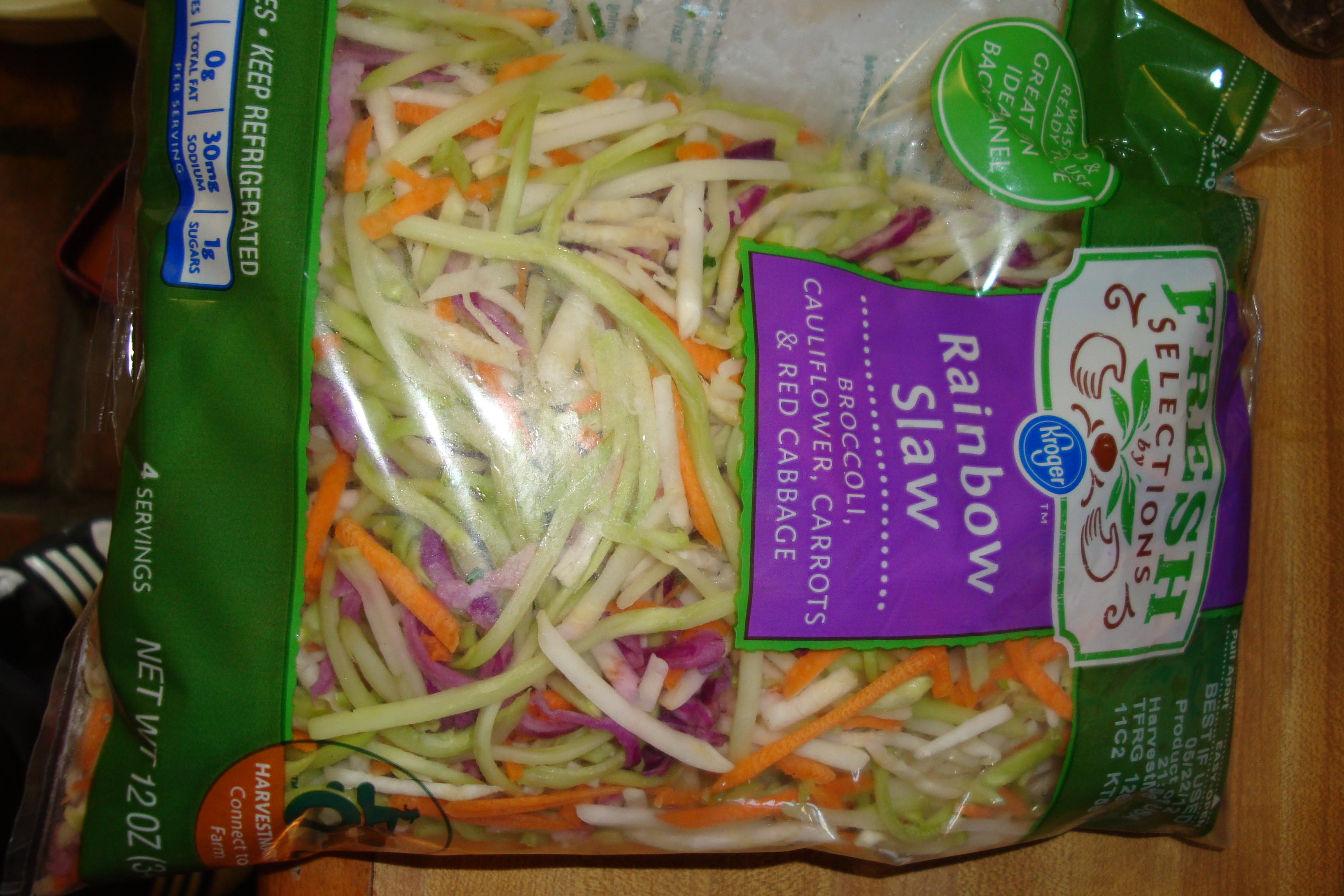
In a small bowl, I mix the dressing, which consists of Miracle Whip, sweet pickle juice (I didn’t have any, so I skimmed some out of the pickle relish jar), and horseradish sauce (for a kick). Some people also like to add vinegar (in place of pickle juice) and dijon mustard.
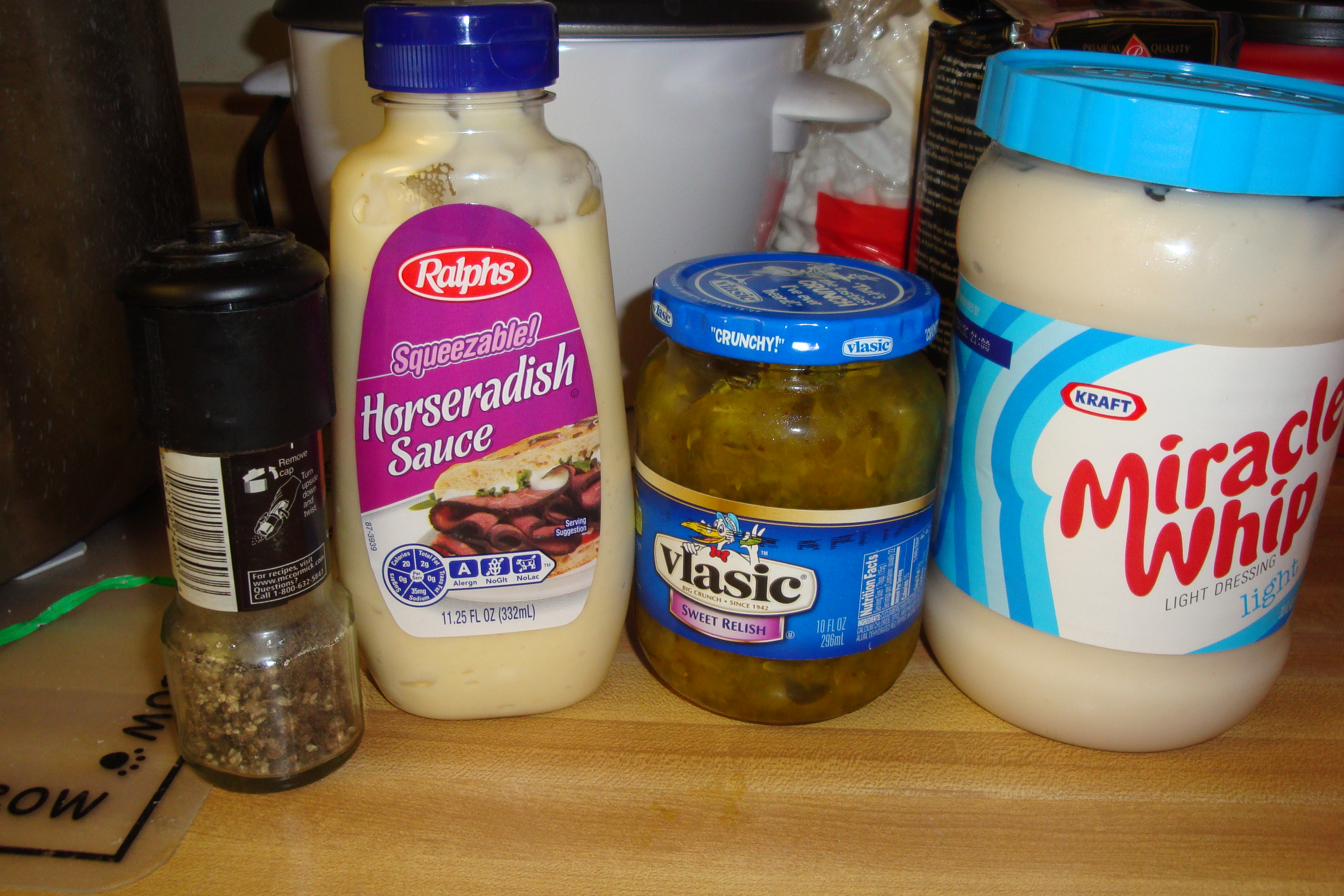
The condiment lineup.
Then I dump the shredded veggies into a big bowl, add a diced tomato, and mix in the dressing. It’s best to refrigerate slaw for a few hours before eating, but I always sneak a few spoonfulls to make sure it tastes right.
Choline count: broccoli, cauliflower, carrot, cabbage, tomato
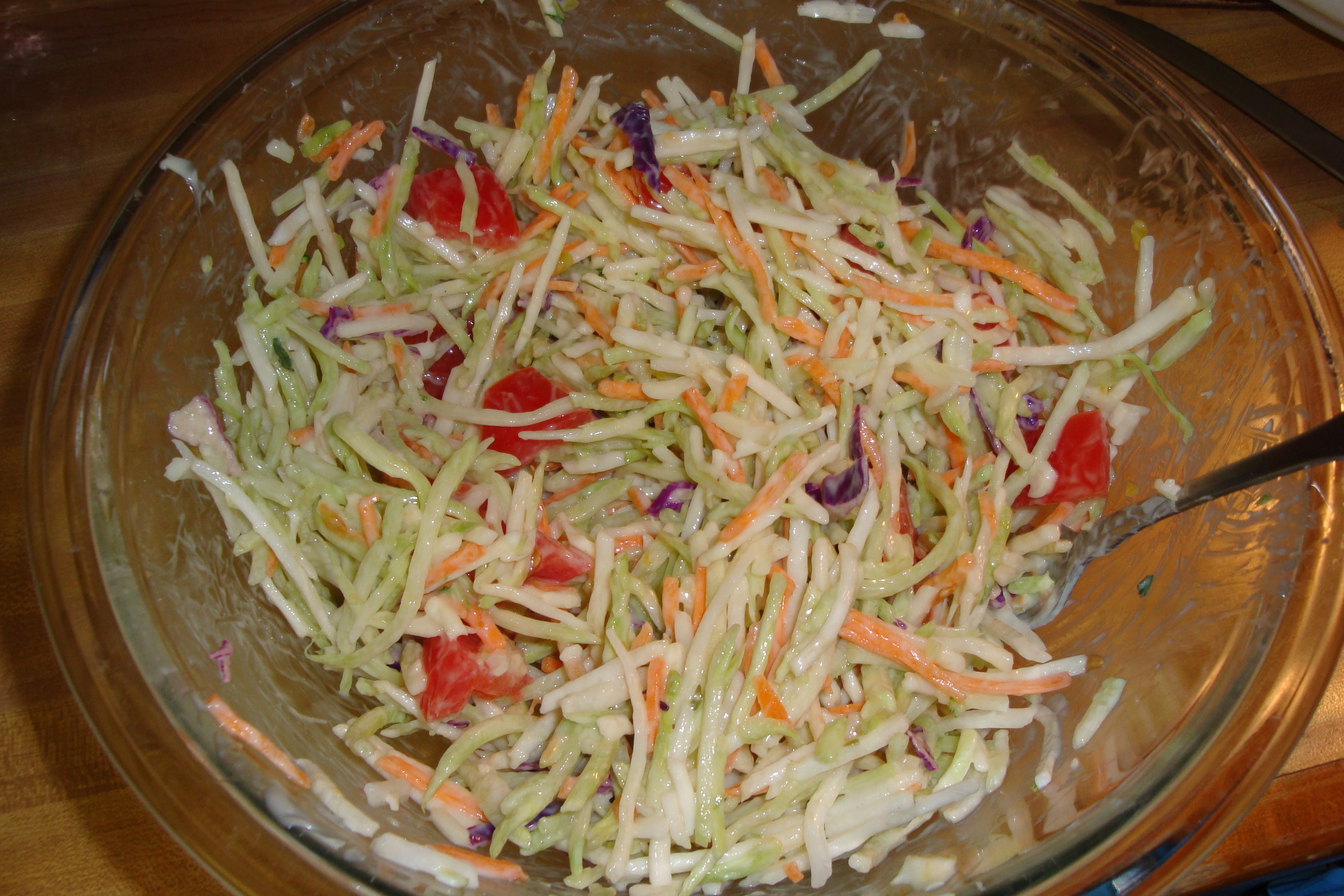
Ready to refrigerate.
California Sandwich
I’ve been eating a lot of sandwiches lately. Boyfriend brought back several loaves of bread from Eric Schat’s Bakery, including some delicious rye bread, so I used some of it to make this sandwich.
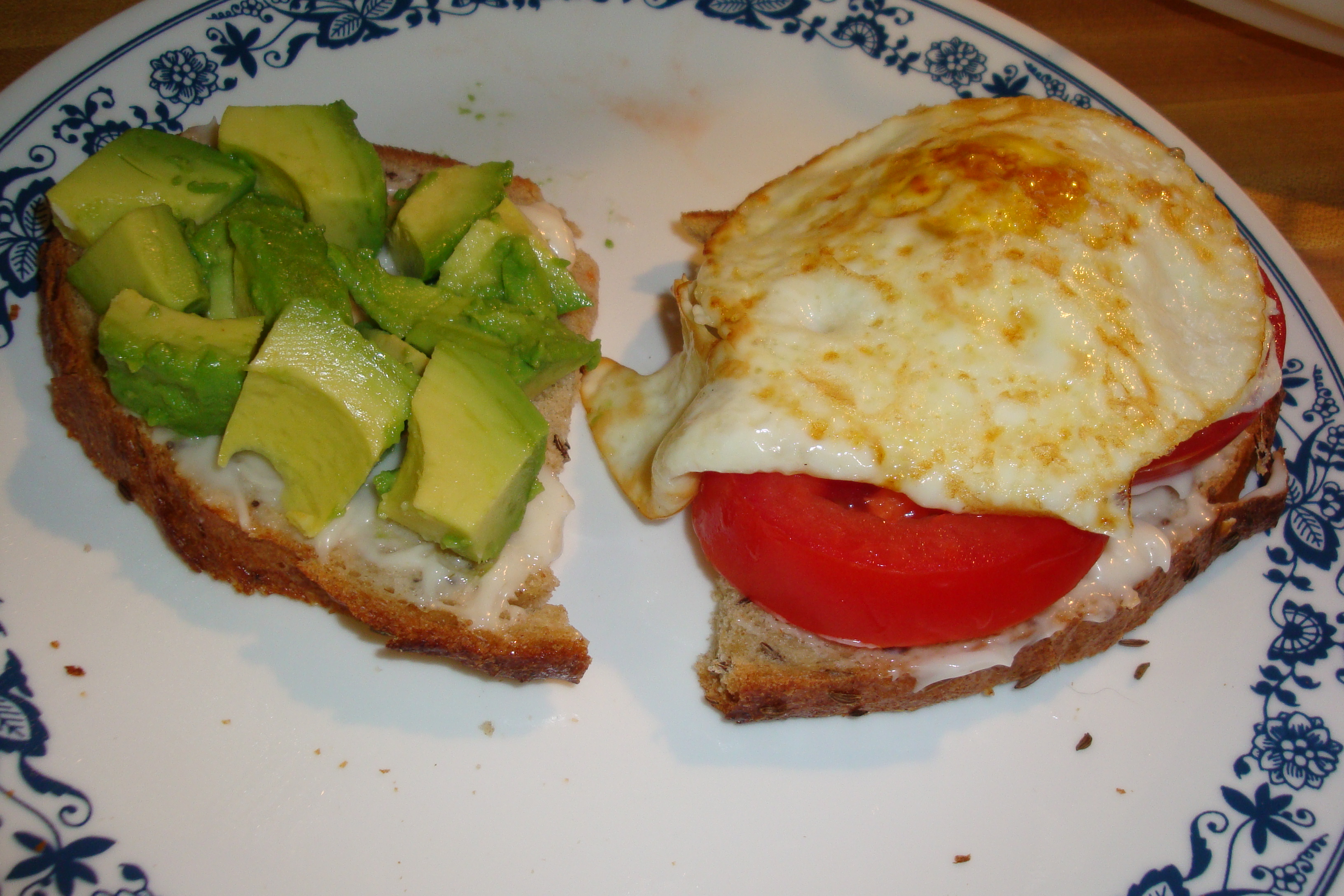
I topped that slice of delicious rye bread with Miracle Whip, horseradish sauce, tomato slices, a fried egg, and half an avocado.
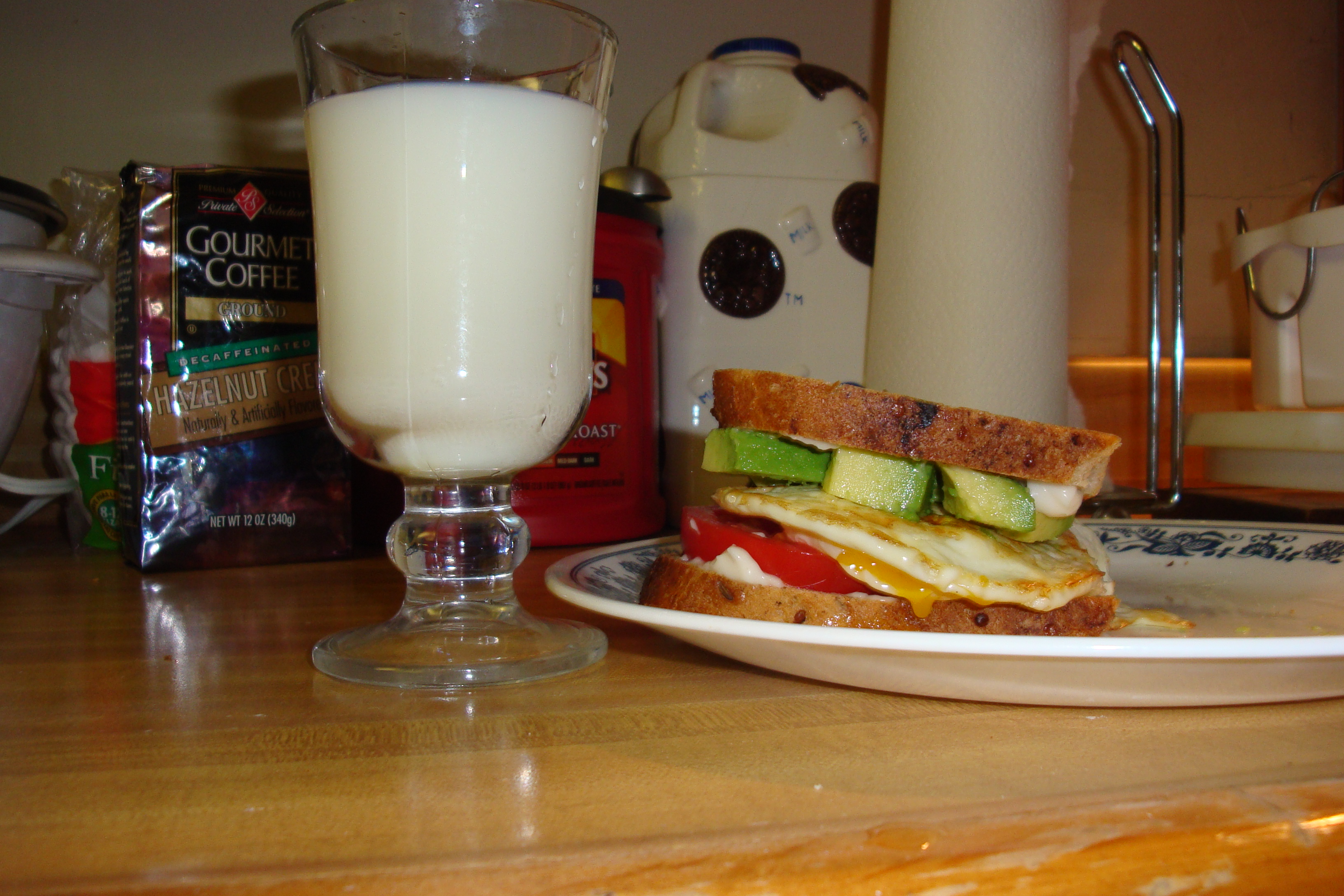
Choline count: fried egg (125 mg) + tomato (12 mg) + 1/2 avocado (9 mg) + rye bread (5 mg) + milk (39 mg) = 190 mg
Chorizo Scramble
Toward the end of the week, I started feeling guilty about eating so much bread, so I cooked up some Mexican chorizo with eggs and topped it with diced avocado and tomato. Cooking for two, I use five eggs and one package (a long link) of chorizo.

Choline count: 2 eggs (250 mg) + chorizo (58 mg) + tomato (12 mg) + 1/2 avocado (9 mg) = 329 mg
Related articles
Eating out {in the name of choline} 05/13/2012
Posted by thetickthatbitme in Choline Diet, Whole Person.Tags: chocolate soufflé, choline, diet, duck, filet mignon, health, hummus, restaurants, Yelp
1 comment so far
One of my dear friends is a new mommy who’s been going a little stir-crazy for the past two months waiting for her son to get his first shots and be allowed to leave the house more regularly. Yesterday, she got a few baby-free hours, which presented a perfect opportunity for some fine dining (or at least what we frugal ladies consider fine dining), and that’s how we found ourselves at a little place called Cafe Mundial in Monrovia.
Now, I must confess, I wasn’t thinking about my choline diet at all as I was scanning drooling over the menu, but it turned out that both my friend and I did fairly well on the choline count without really trying. Here’s what we had:
To Start
This restaurant serves their complimentary bread with a side of hummus (which is really not to be confused with humus). Much to my delight, when I looked up hummus today, I discovered it has 4 mg per tablespoon. (Side note: if you look up “humus,” which is how WordPress spellcheck thinks “hummus” should be spelled, you’ll find it has no choline. So if anyone ever commands you to “Eat dirt!” tell them, “I can’t. I’m on a choline diet.”) We also each ordered the soup du jour, which was tomato basil. (I have no picture of this, and couldn’t find one from Cafe Mundial.) Not much choline in the soup, but it was delicious!
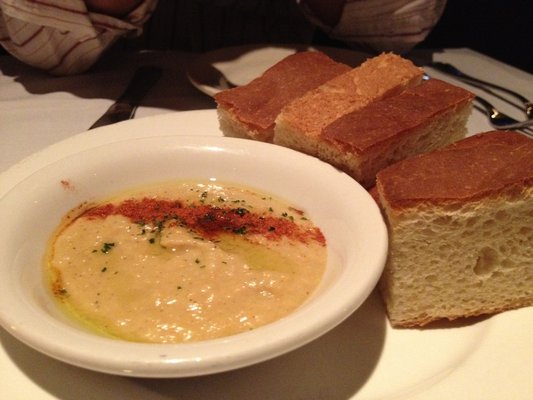
Yummy hummus with bread for dipping. (Image via Yelp)
The Main Course
I had the duck conflit, which was accompanied by a small scoop of mashed potatoes and generous helpings of carrots and zucchini. You can see it pictured below with beans instead. Choline count for roast duck: 43 mg for half a pound. Cooked carrots and zucchini add 7 mg and 8.5 mg choline, respectively, for half a cup each.

Duck Conflit with veggies. (Image via Yelp)
The Finale
Though I admire the philosophy of “Life is short; eat dessert first,” this isn’t really possible with soufflé, owing to the long prep time. It was more like, “Life is short; order dessert first, or else it won’t be ready.” This one was accompanied by fresh strawberry slices and a vanilla bean sauce. We were a few bites into it when I said, “Hold on, I should take a picture of this.” It was just as delicious as it looks. I couldn’t find any nutritional data for chocolate soufflé, but boring old grocery-store-bakery chocolate cake has about 20 mg per slice. With all the eggs and chocolate in soufflé, I’m guessing this little treat comes it at around 30 mg.

Chocolate soufflé, a.k.a. Heaven.
So how well did I fare in the choline department? According to my (rough) estimate, I had about 100 mg of choline. My friend, who ordered the filet mignon (77 mg choline in 3 oz), out-cholined me by about 40 mg.
Related articles
- Snacking in the name of choline
- Omelet you in on these yummy high-choline recipes
- CHOCOLATE SOUFFLÉ FOR VALENTINE’S DAY! (dearmartini.wordpress.com)
Stuff I’ve been tested for and WHY 05/08/2012
Posted by thetickthatbitme in Diagnosis, TBI Facts, Whole Person.Tags: Anaplasma phagocytophilum, Babesia, Bartonella, Borrelia, Ehrlichia, food poisoning, health, labs, Lyme Disease, medicine, pets, Quest Diagnostics, ticks
add a comment
I apologize for the inconsistent posting lately; it’s been a busy couple weeks. No tick-lit today, so I’ll owe you some later in the week!
Tonight’s question: How did my doctor find 3 crazy infections that five other doctors missed? (One of which went undiagnosed for 7 years!)

This is the small binder I carry with me to doctor’s appointments. I have about half a file drawer dedicated to the rest.
Answer: He sent me to get tested for a whole lot of stuff.
How did he know what to order? He considered my risk factors and exposure to disease vectors (like ticks and pets). Is it important for your doctor to know if you’ve been out of the country? If you used to live in another state? If you have pets? If you hike or camp? If you’ve had food poisoning? Yes, yes, yes, yes, and yes!
Below, rather than listing the name of each disease/infection I was tested for, I’ve listed the names of the tests as they appear in my lab reports from Quest Diagnostics. (No, Quest did not pay me to mention their name. I just happen to like them, since they’re always nice to me and their tests helped find my infections.) They’re sorted according to why my doctor thought to order them.

Quest sends me pretty labs in color (as if that matters). Tip: always check the box on your lab slip that says “mail patient a copy” or something like that.
DISCLAIMER: Just because I’ve been tested for something doesn’t mean that you need to be. Only you and your doctor can decide what you should be tested for based on your history, risk factors, and symptoms.
Tick exposure
Borrelia hermsii AB IFA
Ehrlichia chaffeensis IFA
Lyme Disease Antibody (IgG/IgM) Western Blot
WA1 (Babesia duncani) IgG Antibody, IFA
Babesia microti Antibody IgG/IgM
Cat exposure
Bartonella Species Antibody test w/reflex (FYI: One of my cats has tested positive for Bartonella, but I was negative. He’s never scratched or bitten me, but I have been bitten by a different cat.)
Toxoplasma IgG Antibody
Toxocara Antibody, ELISA (serum)
Having food poisoning in Mexico and China
Entamoeba histolytica IgG, ELISA
Giardia lamblia AB Panel, IFA
Helicobacter pylori breath test
Salmonella and Shigella Culture (this was not fun, but I’m glad they were negative)
Camphylobacter Culture
Additional tests:
Immunoblobulins G, A, and M (to see if I was deficient, as this would affect the results of antibody tests and would mean I might need additional treatment, like IVIG—luckily I was not deficient)
CBC (to see if I was low on any particular kinds of blood cells, which might indicate an infection)
Questions? Feel free to comment/e-mail. For whatever reason, I seem to enjoy discussing labs.
Snacking in the name of choline 05/06/2012
Posted by thetickthatbitme in Choline Diet, Humor.Tags: Banana, carrot, choline, eclaire, health, humor, Peanut butter, recipe, Snack food, Sweet potato
2 comments
Since I spend a lot of time working from home, it’s difficult to resist a lot of snacking. Now I believe that eating small meals throughout the day is healthy; however, when you factor in my mighty sweet tooth and the fact that my better half keeps visiting the Entemann’s bakery outlet on his way home from work (he can’t resist the deals), well…you see the predicament. So I decided this week that if I’m going to be ‘bad’ and indulge in a few fattening or sugary or salty snacks, I had better make sure I was getting my choline. Here are some of the choline-rich snacks that my research turned up.
Savory Choline Snacks
Peanut Butter (21 mg in 2 tbsp) and Carrots (6 mg in 1 large carrot)
This is an established favorite for both me and my dad. I used to feel guilty about putting peanut butter on something that is otherwise pretty healthy, but with about 10 mg of choline per tablespoon, I don’t feel that bad. I do, by the way, buy the reduced fat peanut butter. If you prefer almond butter, it has about 8 mg of choline per tablespoon.

Carrot ♥ Jif in my kitchen.
Pistachios (20 mg in 1 oz)
I’m a girl who likes to play with her food, so these are one of my favorite snacks. Sometimes I like to eat them with a few chocolate chips and some dried cranberries. If you’re wondering how many dry roasted pistachios are in an ounce, it’s about 49.

(Image via Wikimedia Commons)
Edamame (56 mg in 100 g—about 2/3 cup)
I usually order edamame (boiled soybean pods) as an appetizer when I go out for sushi with friends. Some grocery stores also have it in the freezer section.

(Image via Wikimedia Commons. Credit: habitatgirl)
Sweet Choline Snacks
Peanut Butter (21 mg in 2 tbsp) and Banana (11 mg)
Yes, you can see I have a propensity to put peanut butter on a lot of things. This is a third-generation snack in my family that originated with my grandma. I find a glass of chocolate milk goes well with it. (One cup of chocolate milk also adds 42 mg of choline!)
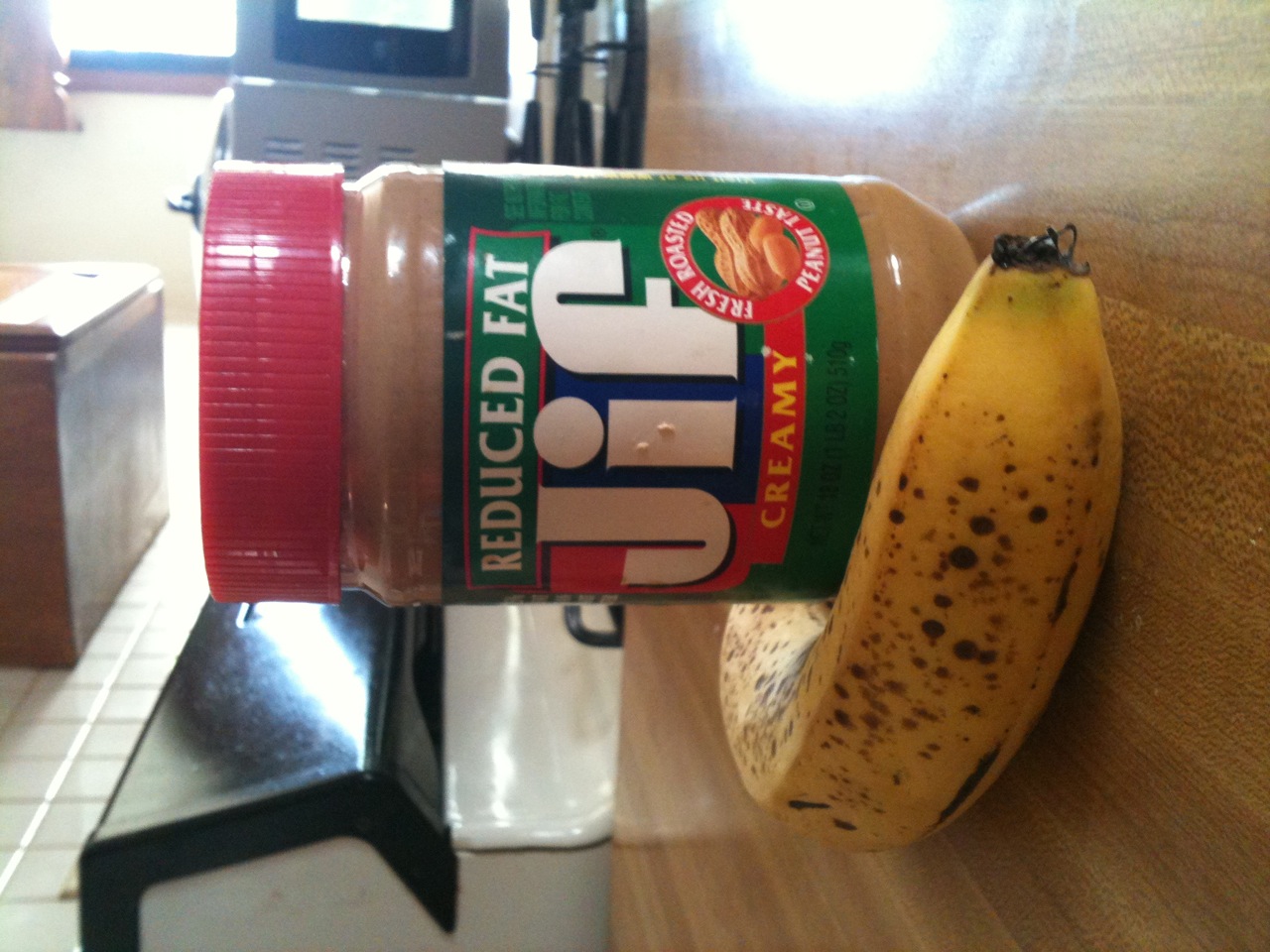
Banana and Jif hanging out on my counter. If Carrot finds out, you are sooo busted, Jif!
Baked Sweet Potato (23 mg for a large one)
Sweet potatoes are so underrated. I try to substitute them for boring old russet potatoes whenever I can, including when I make home-made french fries. The easiest (and laziest) way to prepare a sweet potato, though, it to stab it with a fork a few times and then pop it in the microwave. I like mine with a little butter and brown sugar, but season salt or garlic powder is also good.

(Image via Wikimedia Commons)
Ready for the finale? My most exciting discovery in my choline research is that chocolate is a great source of choline. (Which means, all those times when I was craving chocolate, it wasn’t just me, it was also my neurotransmitters.) I could list about 100 chocolatey snacks here, but I’m going to have some self-restraint and just do one.
Chocolate éclair (79 mg)
This one takes me way back to when I was too short to even see over a bakery counter. (Thanks, Mom, for getting me addicted to these at such a young age.) When I discovered this dessert, I considered changing my name to Claire, just so I could be “Chocolatey Claire.” Is an éclair the same as a doughnut? Of course not, silly! It’s far, far better. I recommend a tall glass of milk with this one.

(Image via Wikimedia Commons. Credit: georgie_grd)
If you want to try making some éclairs from scratch, here’s a yummy recipe over at Moo’s Pantry.
That’s all I’ve got for today. What high-choline treats would you add to this list?
Related articles
- Omelet you in on these yummy high-choline recipes (thetickthatbitme.com)
- Eat Your Eggs, Benedict! (thetickthatbitme.com)
- My Weakness Jif Peanut Butter! (beatcancer2010.wordpress.com)
Ehrlichia: confusing cousins, the blood supply, and the new kid on the block 05/04/2012
Posted by thetickthatbitme in Diagnosis, TBI Facts.Tags: Blood donation, Blood transfusion, CDC, Ehrlichia, health, Lyme Disease, medicine, Minnesota, Rocky Mountain Spotted Fever, tick, Wisconsin
5 comments
Ehrlichia…I just met a girl named Ehrlichia…and suddenly the sound…
Nope. Doesn’t quite work.

Paul Ehrlich (1854-1915). Image via Wikipedia.
Ehrlichia is actually named after German microbiologist Paul Ehrlich (1854-1915), who won the Nobel Prize in 1908. Here are some things you actually need to know about Ehrlichia:
1. Ehrlichia is transmitted through the bites of lonestar ticks and deer ticks. If you’ve had another infection carried by these ticks (like Lyme Disease), your doctor should have had you tested for Ehrlichia (or maybe you’ll be asking him/her to test you after reading this post?).
2. Symptoms of Ehrlichiosis include: fever, headache, chills, malaise, muscle pain, nausea / vomiting / diarrhea, confusion, conjunctival injection (red eyes), and rash (in up to 60% of children, less than 30% of adults). When it goes untreated (or improperly treated), complications can include breathing problems, bleeding disorders, and death (1.8% of cases).
3. Ehrlichia is effectively treated with doxycycline in both adults and children. The CDC recommends a 7-14 day course.
4. Your doctor shouldn’t wait for your test results to come back before prescribing you doxycycline. If your doctor thinks you might have Ehrlichiosis, he/she might order a PCR, a blood smear, or an IFA (antibody test). These tests can take a few weeks to come back, and in that time, you could get very, very sick. In addition, a negative result on any of these three tests does not rule out the possibility of infection. Often, in the first 7-10 days you are infected, you will test negative. For more information about these tests, take a look at the Ehrlichiosis fact sheet.
5. Ehrlichia can be easily misdiagnosed as one of two other infections. It’s a rickettisial disease, which means it’s in the same family with A. phagocytophilum and Rocky Mountain Spotted Fever (RMSF). Sometimes the rash patients get with Ehrlichia looks a lot like the rash patients get with RMSF.
6. It may be possible to contract an Ehrlichia infection through a blood transfusion. The CDC has not been very vocal about it, but it’s on their website. Fun fact: “Ehrlichia chaffeensis has been shown to survive for more than a week in refrigerated blood.” If you’ve had an Ehrlichia infection, it’s probably not a good idea for you to be a blood or organ donor.
7. There’s a newly identified species of Ehrlichia in Wisconsin and Minnesota. It doesn’t have a fancy species name yet, so scientists refer to it as Ehrlichia Wisconsin HM543746 or Ehrlichia muris-like (EML). This one is carried by deer ticks. If you live in one of these states and your doctor is not so hip to the new infectious disease research, he or she may have told you that you didn’t need to be tested for Ehrlichia because “we don’t have that here.” (I hate it when doctors say that!)Hopefully there will be a commercially-available, species-specific test for this soon. For now, my guess is that physicians in Wisconsin and Minnesota who suspect Ehrlichia infection are ordering tests for E. chaffeensis and E. ewingii.
Got an Ehrlichia story you’d like to share? Shoot me an e-mail.
Related articles
5 Things That Helped Me Heal 05/02/2012
Posted by thetickthatbitme in Humor, Whole Person.Tags: Arthritis Foundation, Craig Ferguson, exercise, Geoff Peterson, healing, health, Heating pad, humor, Memory foam, treatment
3 comments
1. Shower chair
We got this after I had my back surgery (to help me avoid bending, slipping, and falling), and I continued to use it after I was diagnosed with hermsii and Anaplasmosis. It really makes a difference being able to sit and relax while bathing. My boyfriend (who is healthy as a horse) also enjoys using it when he just wants to wash his feet!
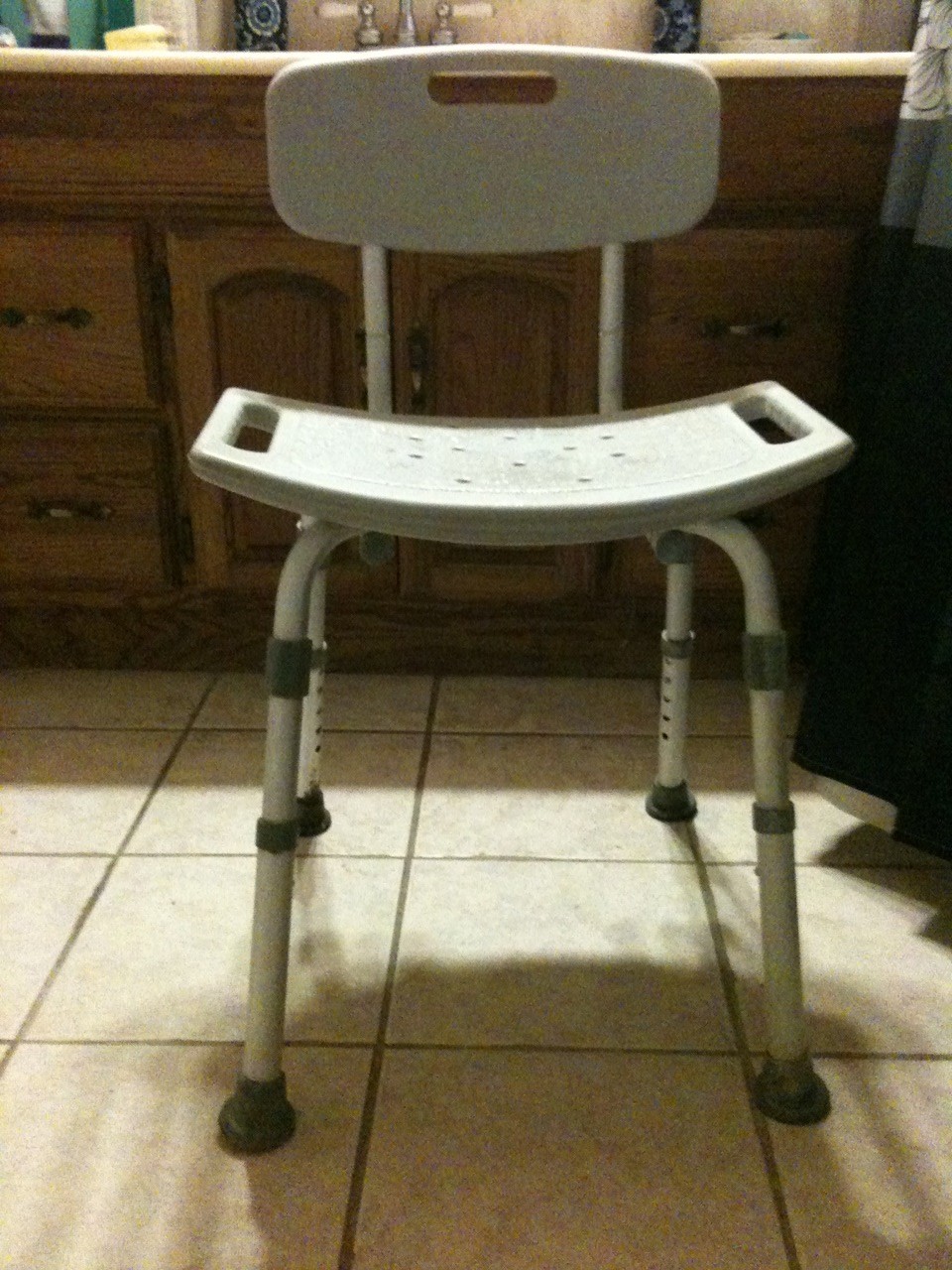
My chair. Note: It only works if you put it IN the shower.
2. Thermalon heating pads
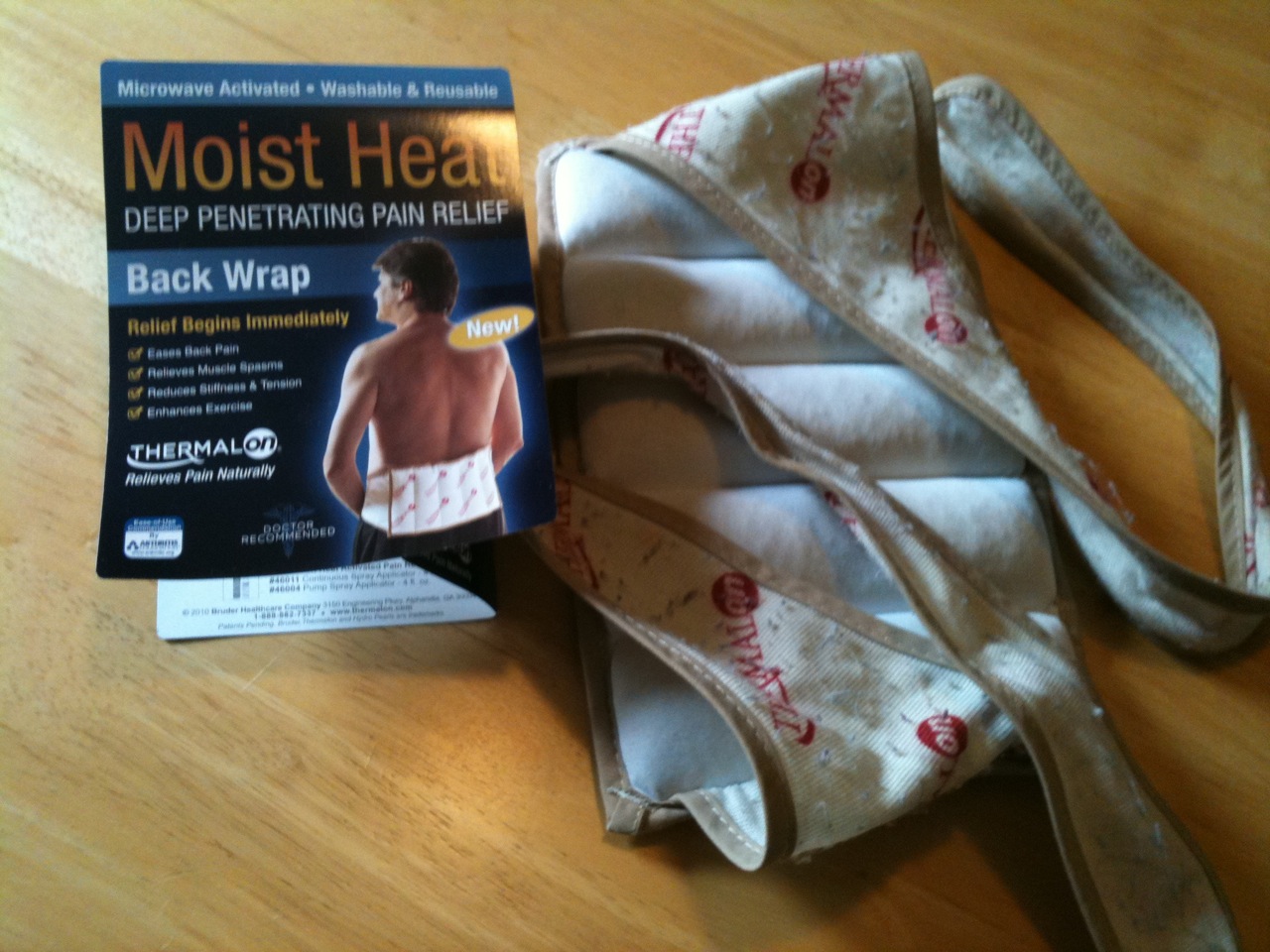
One of my four heating pads.
These heating pads are my best friends. My mom, who has Arthritis, introduced me to them. I put mine in the microwave for about a minute, and it will stay warm for about 30, depending on how cold my house is. After the initial heating, you can reheat them for 30-40 seconds at a time. I prefer these to an electric heating pad because they provide moist heat, and I can fall asleep with one without burning myself. They helped me get off painkillers and sleep better on cold nights. They can also double as cold packs if you store them in the freezer inside a ziplock bag. I found them on sale at Walgreens for $15 each.
3. Low-impact exercise

Image via Arthritis.org
Taking an Arthritis Foundation water aerobics class at a warm water therapy pool helped me stay active while I was getting treated. The warm water helped my joints feel better, and I think all the endorphins from exercising made me happier. I also made some great friends in the class who are just slightly older and much wiser than me. (Shout out to the pool ladies!) If you’re interested in this type of class, you can search for one in your area here.
4. Memory foam mattress pad

This was also a purchase made after my back surgery. My mattress is quite firm. (That’s how I used to like it when I was a young thing with no health problems.) I’ve always slept best on my side, but after surgery, and as I began developing more joint problems in my neck, hips, and knees, the mattress was too hard for me. Rather than shelling out $800 for a new mattress, I spent about $150 for this memory foam mattress topper from Costco. Now the bed is soft enough that I don’t feel like I’m sleeping on a plank, but not so soft that I sink in too far. I’m still able to roll over during the night so I don’t get too stiff.
5. Geoff Peterson
I can’t stress enough how much laughter helped me recover. My parents are a little obsessed with Craig Ferguson, and I started watching him, too, when I was staying with them and getting IV therapy. Craig’s exchanges with his robot sidekick Geoff Peterson make me laugh the hardest.
What are some things that have helped your healing process?
Well, Babs, you’re trickier than I thought 05/01/2012
Posted by thetickthatbitme in Diagnosis, Peer-Reviewed, TBI Facts, Tick-Lit.Tags: Babesia, Blood donation, Blood transfusion, health, IFA, labs, Lyme, medicine, PCR, smear, tick
1 comment so far
Welcome to the second installment of Tick-Lit Tuesday, where I comb through PubMed so you don’t have to. Today’s topic: Babesia and Blood Transfusions. Now, I know I posted about Babesia in the blood supply just a few days ago, but an interesting study has since come to my attention (thanks, Dr. W), and the implications are a bit scary. Okay, get your popcorn and let’s begin.
The Issue:

A blood donation pictogram. Image via Wikipedia.
It has been well-documented that the tick-borne protozoan parasite Babesia can be contracted through blood transfusions. Blood centers aren’t required to test donated blood for Babesia, but this may change in the future, as Babesia infections contracted through transfusions are on the rise. So if we were to test all donors for Babesia prior to donation, which tests should we rely on to detect this pesky parasite? Let’s look at the candidates.
IFA: IFA is an abbreviation for indirect fluorescent antibody test. This type of test can also be referred to as serologic (as in blood serum) testing. If you’ve had one of these tests for Babesia, it’s probably titled something like “WA1 IGG ANTIBODY IFA” (for B. duncani) or “BABESIA MICROTI ABS IGG/IGM” on your lab results. If you’ve had Babesia in the past and been treated for it, your antibody test might still read positive because your body is still making antibodies to the parasite. This is one of the reasons why most insurance companies refuse to pay for treatment for Babesia if your only positive test is the IFA. They think maybe you had a past infection that you got over, so you don’t need treatment. (The other reason they refuse to pay is that they’re jerks, to put it nicely.) I’ll talk more about why this is such a problem later in this post.
A stained blood smear on which B. microti parasites are visible in red blood cells. (CDC Photo: DPDx). Via CDC.gov.
Smear: When we talk about a smear for Babesia, we mean a Giemsa-stained thin blood smear. This test involves looking at blood samples under a microscope to see if there are any parasites hanging around. The problem with this test is that Babesia can infect fewer than 1% of your circulating red blood cells, so it could take many, many smears before any Babesia show up under the microscope. For more information about that phenomenon, read this.
PCR: This stands for polymerase chain reaction. It’s basically a DNA test that tries to identify whether a gene associated with Babesia is present in the blood. PCR has been found to be “as sensitive and specific” as blood smears for Babesia (see this study), which is not saying much, considering the tendency of Babesia to go undetected with smears.
Hmmm, for whom shall I cast my ballot, the antibody test insurance companies don’t trust, the inaccurate smear, or the inaccurate PCR? Choices, choices…
Today’s question:
Can the donated blood of someone with a negative PCR and negative blood smear still be infected with Babesia and cause Babesia infection in transfusion recipients?
(Hint: This is a leading question.)
Let’s talk about a study published in the journal Transfusion in December of 2011 called “The third described case of transfusion-transmitted Babesia duncani.”
Here’s what happened:
In May 2008, a 59 year-old California resident (I’ll call him Cal) with sickle-cell disease had some red blood cell transfusions. Cal’s only risk factor for Babesia was the transfusions; he didn’t have any tick exposure. In September of 2008, Cal was diagnosed with a Babesia duncani (WA-1) infection. The parasites were visible on a blood smear, the indirect fluorescent antibody (IFA) test was positive, and the PCR was positive for the Babesia gene. This launched a transfusion investigation in which doctors tracked down 34 of the 38 blood donors whose blood could have infected Cal with Babesia. One donor, a 67-year-old California resident (who I’ll call Don) had a B. duncani titer of 1:4096 (on the IFA test). What does a titer of 1:4096 mean? Well, if the antibody test for B. duncani is negative, the titer will be < 1:256. That means that Don’s antibody test was positive.
What the article abstract doesn’t tell you, which the full article does, is that both Don’s PCR and blood smear were negative for Babesia. How did the researchers prove definitively that Don had Babesia in his blood? They injected the blood into Mongolian gerbils, and were later able to isolate the parasite from the gerbils. Conclusion: Even though Don showed no symptoms of Babesia and both his PCR and smear were negative, his donated blood caused Babesiosis in both Cal and the gerbils.
Here’s why the study’s findings are important:
1. Clearly, blood smears and PCRs are not good indicators of whether someone is infected with Babesia. Why insurance companies think these tests need to be positive before they’ll pay for treatment is a mystery to me. There are probably a lot of people out there who’ve had positive IFAs but negative smear and/or PCR who were then not treated for Babesia because either the doctor, the insurance company, or both said they didn’t have an infection.
2. As far as the blood donation goes, if we don’t start screening out donors with positive Babesia IFAs, we’re going to continue to contaminate the blood supply with Babesia. It should be as simple as that. Been bitten by a tick? No blood donation for you. Positive IFA? No blood donation for you.
DZWSQK6QYS9G
 THE TICK THAT BIT ME